
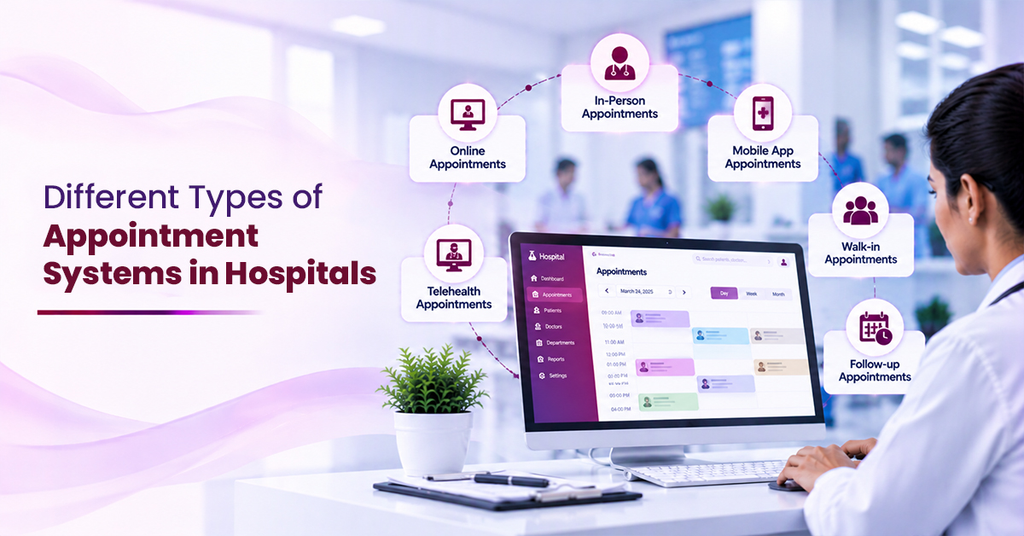
If patients face long delays and staff are constantly overwhelmed, the problem usually lies in the hospital’s scheduling process. An effective appointment system helps hospitals manage patient visits, coordinate doctor schedules, and keep daily operations running smoothly.
In the patient journey, appointment scheduling is the initial touchpoint that shapes a patient’s impression of the hospital. Modern healthcare demands advanced operational management to build a truly patient-centered system.
A chaotic and cumbersome scheduling system creates immediate patient dissatisfaction and disrupts hospital operations. No single appointment system fits every healthcare facility.
Every healthcare facility manages a unique patient demographic with distinct arrival patterns and care requirements. Consequently, a standard scheduling model cannot satisfy every operational environment. Before adopting a system, healthcare administrators must thoroughly analyze their facility’s specific patient behaviors, peak volume hours, and resource demands to select a tailored solution.
Types of Appointment System in Hospitals
The following types of appointment systems differ in how they organize patient arrivals and allocate consultation time.
1. Fixed-Time Appointment System
Under a fixed-time appointment model, care delivery is structured by assigning specific arrival times based on average service durations and provider shift patterns.
2. Wave Appointment System
Under a wave scheduling model, multiple patients are booked at the start of an hour or interval, allowing care teams to capitalize on provider capacity and mitigate the disruptive impact of late arrivals or no-shows. By accommodating variable consultation durations, this approach optimizes throughout if reception and clinical staff maintain tight operational alignment.
3. Modified Wave Appointment System
By segmenting patient cohorts across structured time blocks, modified wave scheduling balances provider utilization with active queue control. Staggering arrival times throughout an operational window ensures a steady cadence of patient arrivals, giving care teams the agility to handle clinical variations without overwhelming reception or clinical holding areas.
4. Open-Access Appointment System
An open-access appointment system keeps capacity available for patients seeking same-day or near-term consultations. This can improve access for patients who cannot plan their consultations far ahead. It may also help departments respond to changing demand.
5. Block Appointment System
Under a block scheduling framework, clinical schedules are partitioned into structured time blocks tailored to service complexity and patient care needs. Allocating targeted blocks for high-acuity intakes separately from lower-complexity follow-ups allows facilities to maximize physician productivity, stabilize room utilization, and improve schedule predictability. It can also help administrators coordinate doctor availability and plan workloads across different clinical services.
6. Priority-Based Appointment System
Priority-based scheduling assigns appointments according to defined clinical needs and urgency. Administrative convenience or booking order should not replace clinical assessment when determining priority.
7. Self-Service Appointment System
A self-service appointment system allows patients to book, reschedule, or cancel appointments independently through online portals, mobile applications, or hospital websites.
Patients enjoy greater convenience while staff see less administrative overhead, making it easier than ever to book appointments. Modern types of appointment software often include self-service features that allow patients to manage their bookings while helping hospital staff handle appointments more efficiently.
8. Online Appointment Booking System
An online appointment booking system enables patients to schedule consultations digitally through a hospital website or mobile application. Patients can check doctor’s availability, select suitable time slots, and receive booking confirmations and reminders.
Integrating the tool with an HMS unifies appointments with registration and daily workflows, creating a frictionless healthcare experience.
9. Recurring Appointment System
A recurring appointment system schedules multiple visits for the same patient at predetermined intervals. It is particularly useful for patients who require regular follow-ups, physiotherapy sessions, dialysis appointments, or ongoing treatment monitoring.
Hospital appointment software can support recurring bookings by organizing future visits and helping staff manage long-term consultation schedules.
10. Automated Appointment Reminder System
The system sends patients appointment reminders through SMS, email, or mobile apps to help them remember their scheduled visits and avoid missing appointments. These reminders may include the appointment date, time, doctor details, and instructions for the visit.
This system helps reduce missed appointments, improves patient attendance, and allows hospital staff to manage consultation schedules more efficiently.
11.Integrated Appointment system
Decentralized, paper-based processes lack real-time visibility, leading to scheduling bottlenecks, high call volumes, and underutilized provider capacity.
The Integrated HMS Software addresses these challenges by providing a digital solution for appointment scheduling and management. Patients can access the system to find doctors, select suitable appointment slots, and manage their bookings without visiting the hospital in person just to schedule a consultation.
Final Thoughts
Optimizing hospital appointments depends on seamlessly integrating patient demand and doctor schedules with operational departmental workflows.
Fixed-time scheduling offers a structured approach, while wave and modified wave methods accommodate variations in consultation duration.
Through the integration of key operational domains, Ezovion HMS drives data-informed hospital administration, ensuring each appointment contributes to high-value care delivery. Enterprise leaders must evaluate scheduling software not in isolation, but as a critical node connected directly to patient registration, care-coordination workflows, queue optimization, and enterprise-wide reporting metrics.
By matching the scheduling approach to their actual requirements, hospital administrators can establish a more manageable appointment process that supports patient access and day-to-day operational efficiency.