Every capital decision in a hospital competes with others, such as a new imaging unit, additional beds, and specialist recruitment. Technology investments often lose that contest because their returns are less visible.
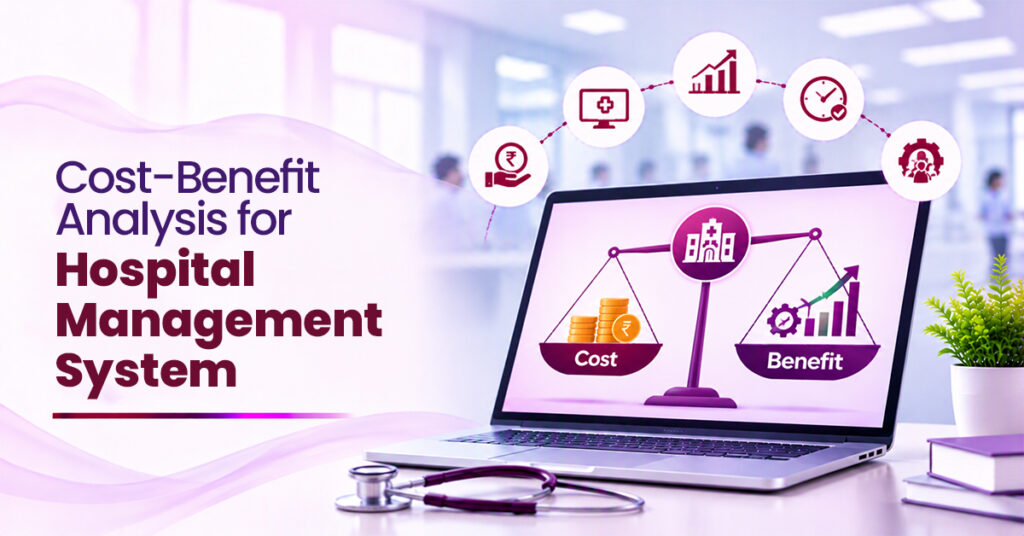
A structured cost-benefit analysis for hospital management system investments changes this. It translates operational improvements into financial terms leadership can evaluate alongside any other investment.
The timing matters. Margins are under pressure from rising staff costs, supply inflation, and tighter payer reimbursement, which leaves little room for avoidable inefficiency. Administrative waste is one of the highest controllable costs in a hospital, and disconnected systems add to it.
When registration, clinical, pharmacy, laboratory, and billing run on separate tools, the cost appears as duplicate data entry, delayed reports, billing leakage, and staff hours spent reconciling records.
This guide sets out how to build that case: what to count, what to measure, and what to watch for.
Why the Business Case Matters
A hospital runs dozens of interdependent processes such as registration, clinical documentation, pharmacy, laboratory, billing, insurance claims, and reporting. When these operate on paper or disconnected tools, the costs rarely appear as one line of items. They show up as unbilled services, rejected claims, expired stock, repeated tests, and long patient waits.
A hospital management system consolidates these functions on one platform. Whether it pays for itself depends on your baseline, your size, and how well it is adopted. That is why a cost-benefit analysis for hospital management software should be completed before vendor selection, not after.
A well-built analysis helps leadership to:
- Quantify the true total cost of ownership, not just the quoted price.
- Locate current revenue leakage and process inefficiency.
- Compare vendors against the same criteria.
- Secure alignment from trustees, clinicians, and finance teams
- Set measurable targets to hold the project accountable.
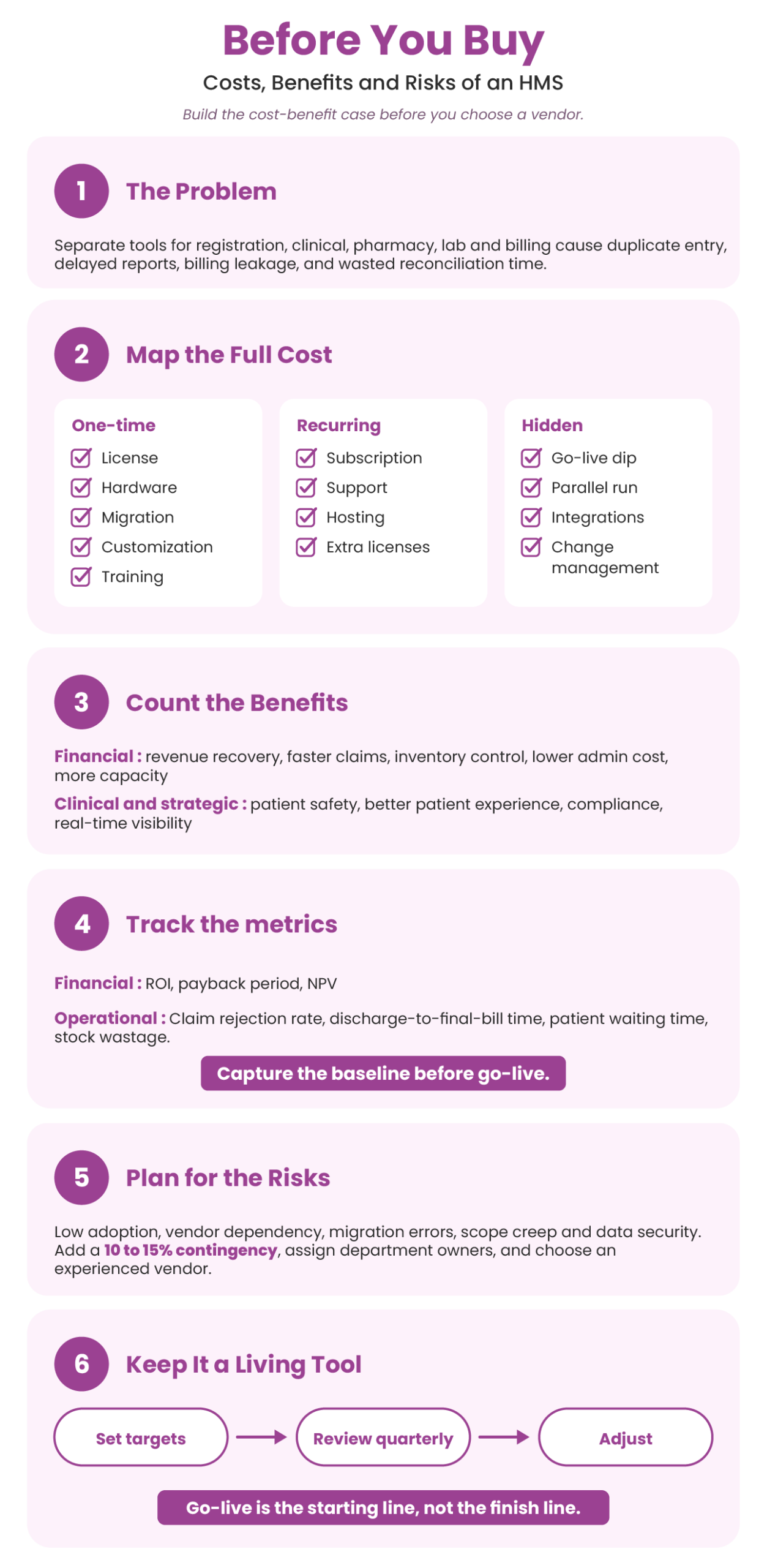
Mapping the Full Cost
Decision makers often see only the licence or subscription fee. The complete picture has three layers.
One-time costs
- Software license or implementation fee
- Hardware and networking (barcode scanners, workstations, printers, backup power), unless the solution is cloud-based
- Data migration from existing records
- Workflow customization
- Initial staff training
Recurring costs
- Annual subscription or maintenance
- Technical support and upgrades
- Hosting and data storage
- Additional user licenses as the facility grows.
- Refresher training for new staff
Hidden costs
- A temporary productivity dip in the first weeks after go-live
- A period of parallel paper and digital operation
- Integration with laboratory analyzers, radiology equipment, and payment gateways
- Management time spent on change adoption
Project these over three to five years to arrive at the total cost of ownership (TCO).
Identifying the Benefits
Benefits fall into two categories, and a credible analysis addresses both.
Financial benefits
- Revenue recovery: Manual billing commonly misses chargeable services and applies to incorrect tariffs. Automated charge capture closes these gaps.
- Faster claim cycles: Complete, standardized documentation reduces insurer and TPA rejections and shortens payment timelines.
- Inventory control: Better stock visibility reduces expiry losses, overstocking, and pilferage in pharmacy and stores.
- Lower administrative cost: Less paper, printing, and physical record storage.
- Capacity gains: Shorter registration and billing times allow more patients to be served with the same resources.
Clinical and strategic benefits
- Patient safety: Structured records reduce prescription errors, duplicate investigations, and missed allergies.
- Patient experience: Faster registration, accurate bills, and appointment scheduling strengthen reputation and retention.
- Governance and compliance: Role-based access and audit trails support data protection and regulatory readiness.
- Management visibility: Real-time dashboards on occupancy, revenue, and departmental performance enable faster decisions.
Some of these cannot be assigned a precise rupee value. They still belong in the analysis, documented as qualitative benefits alongside the financial ones.
Metrics That Hold the Project Accountable
The metrics you use to judge an HMS project should be agreed on before go-live, and the baseline for each one should be captured first. Without a baseline, improvement cannot be demonstrated, and the project cannot be judged.
At the financial level, leadership will want to see ROI and payback period, along with the net present value (NPV) of projected savings. These two measures show whether the investment earns its keep over time and how quickly the hospital recovers its outlay.
Operational indicators then show where that return comes from. The claim rejection rate reveals whether billing accuracy is improving, while discharge-to-final-bill turnaround time shows how quickly completed care converts into revenue. Average patient waiting time reflects the patient-facing effect of smoother registration and scheduling, and pharmacy and inventory wastage percentage captures savings from better stock control.
Tracking these indicators together gives you a complete picture: the financial result, the operational changes behind it, and the evidence to defend the investment when the board asks for proof.
Risks to Build into the Analysis
Any credible assessment acknowledges what could reduce the return:
- Low adoption: The most common reason benefits fall short. Software that staff work around delivers little value.
- Vendor dependency: Weak support or slow issue resolution can disrupt patient care.
- Migration errors: Incomplete or inaccurate records create clinical and billing risk.
- Scope creep: Unchecked customization requests inflate cost and delay launch.
- Data security: Patient data is highly sensitive and requires strong access control, encryption, and backup practices.
Allow a contingency of 10 to 15 per cent in the budget, assign clear ownership in each department, and choose a vendor with demonstrated healthcare experience.
Final Thoughts
A good cost-benefit analysis for hospital management system projects is not a one-time document. Treat it as a living tool, set targets before implementation, review actual results against projections each quarter, and adjust. Hospitals that do this tend to realize more value than those that treat go-live as the finish line.
If you are evaluating options for your facility, the team at Ezovion can help you build a tailored estimate based on your size, specialties, and current workflows, so your decision rests on your own numbers rather than generic benchmarks.