
Healthcare leaders no longer view digital transformation as a technology initiative alone. They expect measurable improvements in operational efficiency, clinical outcomes, financial performance, and patient satisfaction. Modern hospitals require intelligent platforms that connect every department, automate repetitive processes, and deliver real-time insights for faster decision-making.
The right hospital management software modules provide that foundation. Instead of operating multiple disconnected applications, hospitals can unify clinical, administrative, and financial workflows within a single ecosystem. As artificial intelligence (AI), predictive analytics, and cloud computing continue to reshape healthcare, selecting the right modules of hospital management software has become a strategic investment rather than an IT upgrade. Healthcare executives should also evaluate scalability, interoperability, security, and AI capabilities before implementing any solution.
Why Hospitals Need the Right Hospital Management Software Modules
Healthcare organisations face growing pressure from rising patient expectations, workforce shortages, increasing operational costs, and stringent regulatory requirements. Manual processes and fragmented systems slow decision-making, create data silos, and increase the risk of billing errors and clinical inefficiencies.
Modern hospital management systems modules address these challenges by integrating every department into one intelligent platform. Rather than switching between isolated applications, clinicians, administrators, and finance teams access accurate information from a single source of truth. This unified approach improves collaboration, accelerates patient care, and strengthens financial control.
Choosing the right hospital management tool also enables hospitals to automate repetitive administrative tasks, reduce paperwork, improve patient flow, and enhance operational visibility. Hospitals that invest in integrated hospital management solution gain greater agility while positioning themselves for sustainable growth.
Evolution of Hospital Management Systems
| Technology Era | Primary Focus | Key Capability |
| Traditional HIS | Digitising patient records | Electronic record management |
| Cloud-Based HIMS | Centralised access | Remote accessibility & real-time data sharing |
| AI-Powered HIMS | Intelligent decision-making | Predictive analytics, automation & resource optimisation |
AI Evolution: From Automation to Intelligent Hospital Management Systems Modules
Healthcare technology has evolved significantly over the past decade. Early hospital information systems focused primarily on digitising records and replacing paper-based workflows. Cloud technology later improved accessibility and simplified system maintenance.
Today, AI-powered hospital management systems modules go much further. Machine learning analyses operational trends, predictive analytics forecasts patient demand, and intelligent workflow automation reduces manual intervention across departments. AI also supports clinical documentation, recommends appropriate workflows, and optimises hospital resources based on real-time data.
These advancements transform modules of hospital management tools into proactive decision-support tools rather than simple record-keeping systems. As a result, healthcare leaders gain better visibility, faster insights, and stronger operational control across the organisation.

10 Essential Hospital Management Software Modules Every Future-Ready Hospital Needs
Integrated hospital management solution deliver significantly greater value than standalone applications because every department shares accurate, real-time information. The following modules form the foundation of a high-performing hospital.
1. Smart Patient Registration and Appointment Management Module
Efficient patient registration reduces waiting times and improves the overall patient experience. AI-powered scheduling, digital check-in, automated reminders, and smart queue management minimise appointment delays and reduce no-shows. These management software modules help hospitals improve OPD system efficiency while increasing patient satisfaction.
2. AI-Powered Electronic Medical Records (EMR) Module
Among the most valuable modules of hospital management software, the EMR module centralises patient histories, diagnostic reports, prescriptions, and treatment plans. AI-assisted documentation, voice recognition, and clinical decision support reduce documentation time while helping clinicians make faster and more informed decisions that improve patient safety.
3. Intelligent Billing and Revenue Cycle Management Module
Financial performance depends on accurate billing and efficient claims management. Intelligent hospital management systems modules automate insurance verification, billing workflows, fraud detection, and revenue analytics. Hospitals benefit from fewer billing errors, quicker reimbursements, and reduced revenue leakage.
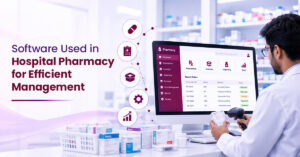
4. Pharmacy and Inventory Management Module
Effective inventory management ensures continuous medicine availability while reducing waste. AI forecasts demand, tracks expiry dates, automates procurement, and maintains optimal stock levels. These hospital management solution’s modules help hospitals lower inventory costs without compromising patient care.
5. Laboratory and Diagnostic Management Module
Integrated laboratory management streamlines test requests, report generation, and diagnostic workflows. AI-assisted reporting and seamless integration with EMR systems improve turnaround times while enabling clinicians to access accurate diagnostic information quickly.
6. Bed Management and Resource Allocation Module
Real-time visibility into bed occupancy improves admission planning and discharge coordination. Predictive analytics forecasts bed availability and supports better capacity management. These modules of management software help hospitals reduce waiting times while improving patient flow across departments.
7. Operation Theatre Management Module
Efficient operation theatre scheduling maximises surgical capacity. AI coordinates surgeon availability, equipment allocation, staff scheduling, and procedure planning. These hospital management systems modules improve OT utilisation, reduce cancellations, and increase surgical throughput.
8. HR and Workforce Management Module
Healthcare workforce management requires intelligent scheduling and resource planning. AI optimises shift allocation, automates attendance tracking, forecasts staffing requirements, and measures workforce performance. Hospitals improve staff productivity while reducing administrative effort and employee burnout.
9. Hospital Analytics and Executive Dashboard Module
Healthcare executives require immediate access to operational and financial performance indicators. Advanced dashboards consolidate clinical, financial, and departmental KPIs into actionable insights. These hospital management software modules enable faster strategic decisions, greater operational transparency, and stronger organisational performance.
10. AI-Powered Patient Engagement Module
Patient engagement extends beyond hospital visits. Digital patient portals, teleconsultations, personalised communication, chatbots, and automated follow-ups strengthen patient relationships throughout the care journey. Integrated hospital management systems modules improve patient retention while enhancing satisfaction and continuity of care.

Impact of AI-Powered Hospital Management Systems Modules
| Operational Area | Traditional Approach | AI-Driven Improvement |
| Clinical Documentation | Manual data entry | 30–50% less documentation time |
| Patient Demand Forecasting | Historical estimates | 88–95% forecasting accuracy |
| Hospital Resource Management | Reactive planning | 10–20% better staff utilisation |
| Inventory Management | Manual stock monitoring | 40–70% reduction in inventory wastage |
| Billing & Claims | Manual validation | 40–60% fewer claim rejections |
Why Ezovion Delivers the Most Complete AI-Powered Hospital Management Software Modules
Hospitals and clinics need more than standalone applications to stay competitive—they need an intelligent, connected platform that unifies every aspect of healthcare delivery. Ezovion offers one of the industry’s most comprehensive AI-powered Hospital Information Management Systems (HIMS), bringing together more than 50 integrated hospital management software modules on a single cloud-enabled platform. From patient registration and Electronic Medical Records (EMR) to pharmacy, laboratory, revenue cycle management, analytics, workforce management, interoperability, and patient engagement, every module works together to create a seamless digital healthcare ecosystem.
Unlike traditional solutions, Ezovion combines advanced AI and machine learning with intelligent workflow automation, speech-to-text clinical documentation, predictive analytics, robotic process automation, executive dashboards, and FHIR/HL7 interoperability. These advanced modules of hospital management solution help healthcare providers improve operational efficiency, optimise resource allocation, reduce administrative workloads, accelerate clinical decision-making, and enhance patient outcomes. Its HIPAA-compliant cloud infrastructure, multilingual capabilities, customisable deployment options, and seamless integration with existing healthcare systems make it suitable for hospitals and clinics of every size across the globe.
For healthcare organisations seeking future-ready hospital management systems modules, Ezovion delivers scalability, security, interoperability, and AI-driven intelligence within a single platform. Its connected approach empowers healthcare leaders to improve profitability, strengthen patient experiences, and confidently embrace the future of digital healthcare through an intelligent hospital management software and fully integrated hospital management systems.
Conclusion
Healthcare organisations require more than digital records to remain competitive. They need intelligent platforms that unify operations, strengthen clinical decision-making, and improve financial performance across every department.
The right hospital management solution enable hospitals to streamline workflows, optimise resources, enhance patient experiences, and make data-driven decisions with confidence. Carefully selected modules of management software also prepare healthcare organisations for future innovations in AI, predictive analytics, and connected care.
Modern hospital management systems modules therefore represent a strategic investment that delivers long-term operational resilience, higher profitability, and sustainable growth. Solutions such as Ezovion combine advanced AI capabilities, interoperability, and scalable architecture to help hospitals embrace the next generation of healthcare transformation through intelligent hospital management software and fully integrated hospital management systems.