Anyone who has spent a week in a hospital or a busy clinic knows the story. There are more patients than there were last year, and fewer hands to look after them. Paperwork keeps piling up. Patients, meanwhile, want quicker answers and care that feels like it was meant for them. AI isn’t a cure for all of that, but it is one of the few tools that takes real weight off people’s shoulders.
In simple terms, it’s software that learns from medical and operational data, spots patterns, and helps people make decisions. Under the hood, you’ll find machine learning, natural language processing (NLP), computer vision, and prediction models. Most healthcare AI solutions are built from these pieces, and many now come into modern healthcare software rather than standalone tools.
It will not replace your doctors, nurses, or admin staff. The places where it works best are the ones where it behaves like a quick, tireless assistant. It handles repetitive, data-heavy chores so your people can spend their time on judgment, conversation, and care.
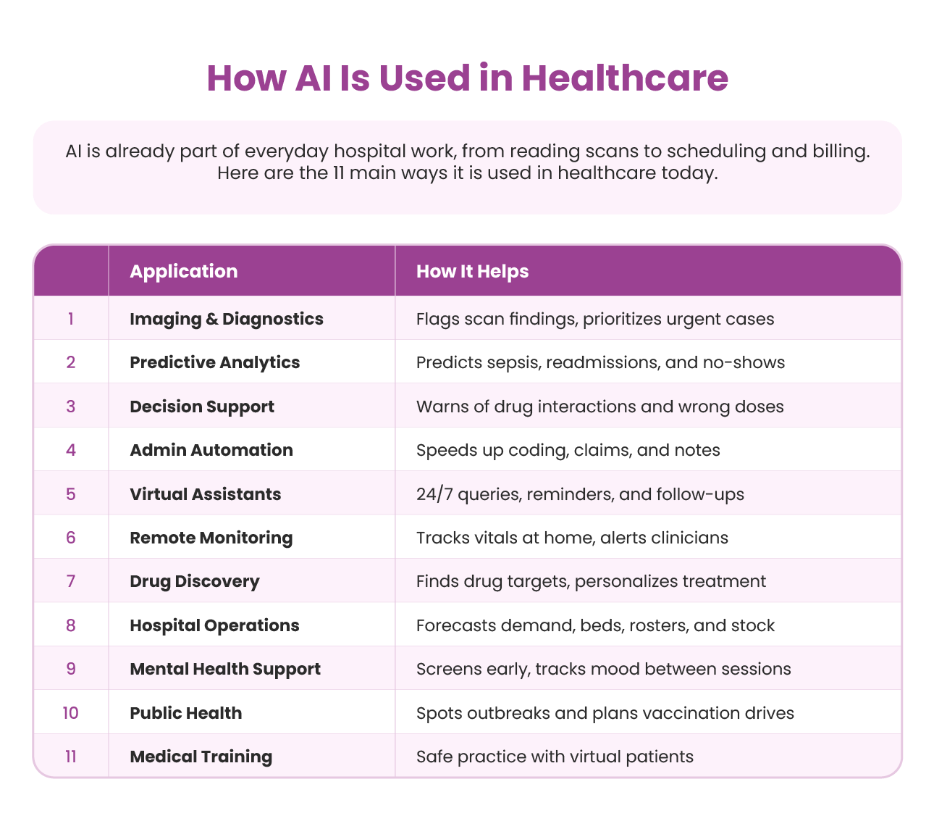
How AI is Used in Healthcare
1. Medical Imaging and Diagnostics
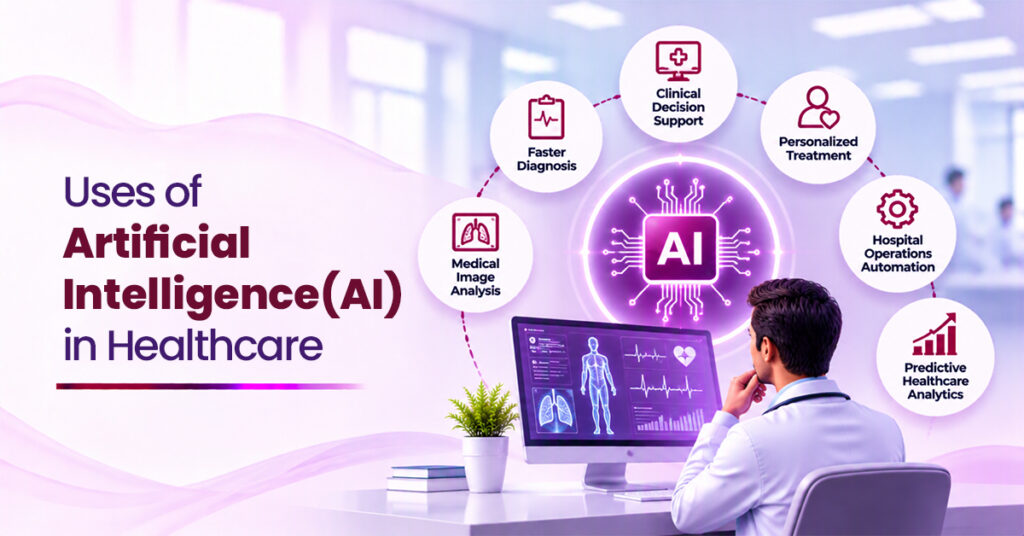
Models trained on huge sets of scans can help radiologists and pathologists notice what the eye might miss on a long shift. They work on X-rays, CT, MRI, mammograms, and digital tissue slides. In radiology, they pick up lung nodules, fractures, brain bleeds and early signs of stroke. In pathology, they help find cancer cells and grade tumors more quickly.
Two uses matter most in practice. The first is queue prioritization, where a suspected bleed jumps to the top of the reporting list instead of waiting its turn. The second is screening where specialists are scarce, such as breast cancer, tuberculosis, and diabetic retinopathy programs. The diagnosis still belongs to the clinician.
2. Predictive Analytics and Early Warning
Feed a model of patient histories, vitals, labs and admission data, and it can estimate who is likely to develop sepsis, deteriorate on the ward, come back within 30 days, or simply not turn up for an appointment. An alert hour earlier can change the outcome.
Clinics use no-show predictions to overbook sensibly and send reminders to the patients most likely to slip. Care teams use readmission scores to decide who needs a follow-up call after discharge. Public and private programs use risk groupings, say diabetic or cardiac patients, to target preventive outreach.
3. Clinical Decision Support
These tools read a patient’s record and bring up what’s relevant, including guidelines, possible diagnoses, suggested tests, and warnings about drug interactions, allergies or wrong doses now of prescribing. They help clinicians stay consistent, especially in complicated or time-critical cases.
The better systems also fight alert fatigue. Anyone who has clicked through a hundred meaningless pop-ups knows why that matters.
4. Administrative Automation
A big slice of what healthcare costs go to administration, and this is where AI often pays off first. It can handle scheduling, medical coding, claims, insurance checks, and billing reviews.
Coding tools suggest codes from clinical notes, which means fewer rejected claims. Eligibility checks and fraud flags happen before a claim goes out. When these features sit inside your HMS, the data flows from registration to billing without being re-entered.
Documentation is the one doctors tend to notice. Speech recognition and NLP can turn a consultation into a draft visit note or discharge summary, cutting down the typing that contributes so heavily to burnout.
5. Virtual Assistants and Patient Engagement
Chatbots answer routine questions at any hour, send medication and appointment reminders, walk patients through pre-visit instructions, and check in after discharge. Good ones can work in several languages and escalate to a human when something sounds wrong. Patients can book, download reports or request a refill without waiting on hold, and your front desk and call center get time back.
Symptom checkers can help point people to the right level of care, from home remedies to the emergency room. They should be treated as guidance, not a diagnosis.
6. Remote Patient Monitoring
Wearables and home devices produce a steady stream of heart rate, glucose, blood pressure, and oxygen readings. AI watches for worrying trends and pings for a clinician. That makes it far more realistic to manage diabetes, hypertension, and heart conditions between visits, to monitor patients recovering from surgery at home, and to detect falls or unusual behavior in older adults living alone.
Hospital-at-home models depend on exactly this, and it is one of the clearest examples of AI use in healthcare today, with one team supervising many patients through automated alerts.
7. Drug Discovery and Personalized Medicine
On the research side, AI helps find promising drug targets, designs smarter clinical trials, matches patients to trials, and predicts which sites will recruit well. In pharmacogenomics, it estimates how someone’s genes will affect their response to a drug.
That feeds into tailored treatment, particularly in oncology and rare diseases. Timelines shrink, though bringing a drug to the market still takes years.
8. Hospital Operations and Resource Planning
Hospitals are businesses as much as medical institutions. Forecasting models predict emergency department crowding and admission peaks, improve bed turnover, cut idle time in operating theatres, and line up nurse and doctor rosters with the expected load. A connected HMS gives these models the live data they need to be useful.
On the supply side, they help pharmacies and stores avoid both stock-outs and wastage. Patients feel the difference as shorter waits, and the finance team feels it too.
9. Mental Health Support
Some tools screen early for depression and anxiety, deliver guided cognitive behavioral therapy exercises, and track mood over time, which makes mental health a growing area for the use of AI in healthcare.
They don’t stand in for a therapist. What they can do is give people something between sessions and help clinicians notice who needs urgent attention.
10. Public Health and Disease Surveillance
By combining health records, lab data and even news and social media signals, AI can spot outbreaks sooner, forecast how a disease will spread, and help plan vaccination drives. Authorities can move resources before a surge arrives rather than after.
11. Medical Training and Simulation
Simulators and virtual patients let students and nurses practise procedures and clinical reasoning without risk to a real person, and they get feedback straight away.
Final Thoughts
We can expect AI to keep growing in healthcare. Some tools already listen to a visit and write notes for the doctor. Soon, AI assistants will be able to sum up a patient’s long history in seconds. Sorting patients’ urgency will get smarter too, and the hospital management system, diagnostic tools and patient apps will all share information in real time.
Providers like Ezovion are part of this shift toward connected platforms, where the HMS and other healthcare software work together.
The organizations that will adopt these tools most smoothly are the ones doing the unglamorous groundwork now, meaning clean data, connected systems, and staff who trust the tools because they were involved in choosing them.