
A hospital treats the patient first and gets paid later. In between, money goes missing in ways that rarely get noticed until the month-end report arrives, such as a denied claim here, a coding slip there, or a wrong insurance ID entered at the front desk weeks ago.
Good revenue cycle management closes that gap. Cash comes faster, fewer bills get written off, and clinical staff spend less time on paperwork. This guide covers the revenue cycle management best practices that high-performing hospitals follow across seven stages, the numbers worth tracking and the role of technology.
Costs keep climbing, payer rules are getting more complicated, and patients are paying a bigger share of their own bills. With margins this thin, even a small gain in clean-claim rate or a few fewer days in accounts receivable can free up significant working capital.
Following proven hospital revenue cycle management best practices is one of the fastest ways to protect those margins.
How the Revenue Cycle Works, Step by Step
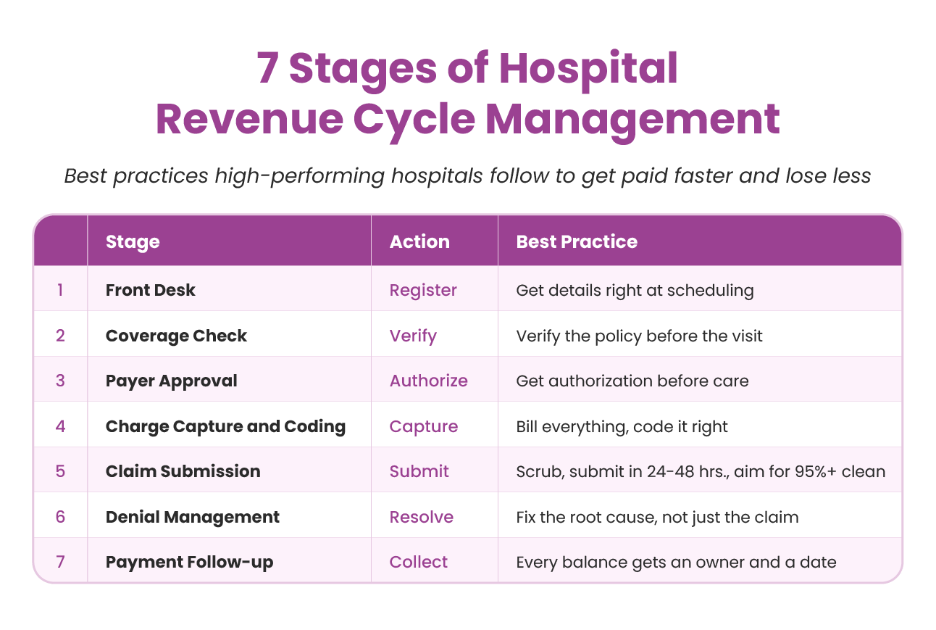
1. Getting the Front Desk Right
Most denials start at the front desk. A misspelled name, a wrong date of birth, or an incorrect insurance ID travels with the claim and eventually comes back as a rejection.
Collect complete patient details at scheduling or pre-registration, not at discharge, including insurer, policy number, TPA details and referral information. Give registration staff a short checklist and show them their error rates regularly. Fixing a mistake here takes minutes. Fixing it after a denial can take days.
2. Confirming Coverage Before Care Begins
An expired policy or exhausted coverage limit is one of the most avoidable reasons for non-payment. Check out eligibility before the visit, such as whether the policy is active, what it covers, what the co-pay and deductible are, and whether the planned procedure falls within benefits.
Then give the patient a plain-language estimate of what they are likely to owe.
3. Securing Payer Approval in Advance
For planned procedures and admissions, approval from the payer or TPA should be in hand before care begins. Missing authorization is a common cause of denials and is almost impossible to fix after the service is delivered. Define who requests approval, what documents are attached and how responses are tracked.
Record the authorization number and approved amount where billing can see them, so the final claim matches what the payer agreed to. For emergencies, follow up on intimation and approval quickly after admission.
4. Billing Every Service and Coding It Correctly
Missed charges are revenue that quietly disappears. Medications, consumables, diagnostics, bed days and procedure add-ons slip through easily when charge entry depends on paper.
Tie charge capture to the clinical workflow, so billable items are created as care happens. Review the charge master at least annually, reconcile department charges against billed items daily, and audit high-value areas like the ICU and operating theatres regularly.
Coding is the other half. Thin documentation leads to under-coding, which costs revenue, or over-coding, which creates compliance risk. Keep coders current on ICD, CPT and payer guidelines, run a clinical documentation improvement program, and audit codes before bills go out.
5 . Sending Claims That Get Paid the First Time
Use automated claim scrubbing to catch missing fields, code mismatches and payer rule violations before submission.
Aim to submit within 24 to 48 hours of discharge and update payer-specific rules whenever policies change. A first-pass clean-claim rate of 95 percent or higher is a reasonable target, though benchmarks vary by payer mix and region.
6. Fixing Rejections and Learning from Them
Some denials are unavoidable. Repeated ones point to something broken upstream. Adopting a best-practice revenue cycle management approach to denials means fixing causes, not just claims.
Log each denial by reason, payer, department and root cause. Work high-value claims first, set firm appeal turnaround times, and keep templates and supporting evidence ready for common appeal types.
Most importantly, review denial trends monthly and trace problems back to registration, eligibility, authorization or coding, then fix them at the source. Hospitals that analyze patterns instead of only reworking individual claims usually see denial rates fall steadily.
7. Chasing Payments and Measuring Results
Every unpaid claim and patient balance needs an owner and a follow-up date. Keep claim statuses in one place, so ageing claims are escalated early.
For patients, send clear itemized bills, offer several payment options, and use reminders by SMS, email or WhatsApp.
Connecting the Cycle with the Right Technology
Spreadsheets and disconnected tools make it hard to follow a patient’s financial journey. Modern revenue cycle management software brings registration, eligibility, authorization, billing, claims, TPA coordination and reporting into one workflow and cuts the repeated data entry that causes errors.
When evaluating options, look for integration with clinical, lab, pharmacy and inpatient modules, real-time insurance and TPA workflows, automated charge capture and claim scrubbing, denial analytics, role-based access with audit trails, and scalability across departments and branches.
A unified HMS software platform makes a real difference. When billing sits in the same system that handles admissions, orders and discharge, charges flow through automatically, and everyone works from the same information.
Ezovion HMS is built around this idea, linking patient care workflows with billing and insurance so fewer charges are missed, and fewer claims come back.
Staying Audit-Ready and Building the Right Team
Billing errors can become regulatory and reputational problems. Keep policies aligned with payer contracts and regulations, maintain audit trails for charges, edits and approvals, run periodic internal audits, and protect patient data with strict access controls.
Assign clear ownership for each stage, train staff regularly on payer updates and coding changes, set targets, and hold a short monthly review where finance, clinical and operations leaders compare notes.
Final Thoughts
Strong revenue cycle management comes down to getting each of the seven stages right, from the front desk and coverage checks through approvals, coding, clean claims, denial management and disciplined follow-up.
Add regular KPI tracking, a connected HMS software, trained staff and audit-ready processes, and hospitals see fewer denials, steadier cash flow and more time for patient care.
If your team is struggling with high denial rates, slow collections, or disconnected billing systems, it may be time to look at your processes and technology together. Talk to the Ezovion team to see how an integrated HMS can bring smoother billing, better claims and clearer financial visibility to your hospital.