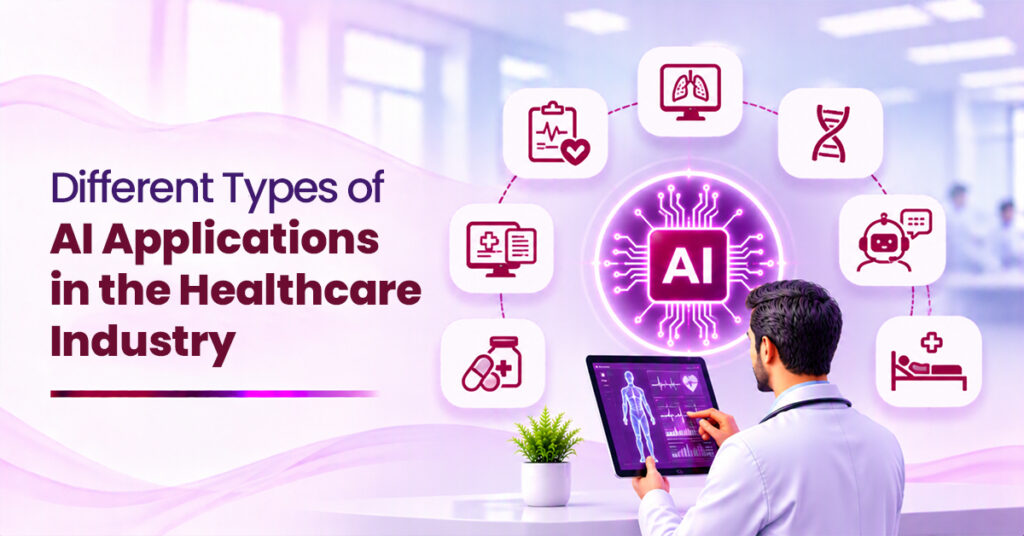
AI is already reading scans, flagging high-risk patients, transcribing consultations, and automating billing queues in hospitals around the world.
But for most healthcare leaders, the real challenge is not whether to adopt AI. It is understanding which kind of AI solves which problem.
A tool that predicts sepsis from vital signs works very differently from one that drafts discharge summaries or guides a surgical robot. If you are evaluating technology for your hospital, clinic or healthcare system, you need clarity on the types of AI in healthcare, what each does, and where it delivers measurable value.
Types of AI Applications in Healthcare
Hospitals are under pressure to deliver better outcomes with limited time, staff and budgets, and healthcare AI solutions are helping both the clinical and administrative sides.
If you’re researching what are the type of AI used in healthcare, this section breaks them down into clear categories, showing what each one does and where it adds value. By the end, you’ll know which technologies to explore first.
1. Machine Learning and Predictive Analytics
ML models learn from historical data to predict future outcomes, without being explicitly programmed with rules.
Clean, structured and consistently captured records are the foundation, which is why the quality of your underlying healthcare software matters as much as the algorithm itself.
- Identifying patients at high risk of readmission, deterioration or chronic disease complications
- Detecting sepsis, cardiac events or acute kidney injury hours before they become critical
- Predicting appointment cancellations, bed occupancy and emergency department footfall
- Segmenting patient cohorts for preventive outreach
2. Natural Language Processing (NLP)
Around 80 percent of clinical information is commonly estimated to be unstructured, such as physician notes, referral letters, radiology reports, and discharge summaries. NLP enables machines to read, interpret and structure that free text.
For physicians dealing with documentation fatigue, NLP is one of the most immediately felt types of AI applications in healthcare.
- Extracting diagnoses, medications and allergies from clinical notes
- Automated medical coding to support accurate billing
- Clinical documentation improvement
- Speech-to-text and ambient scribing, which reduces after-hours charting for doctors
- Mining records for clinical research and trial matching
3. Computer Vision and Medical Imaging AI
Since medicine is deeply visual, this has been one of the most mature and clinically validated areas of AI.
Imaging AI typically acts as a second reader or triage assistant. It prioritises urgent cases in a radiologist’s worklist and highlights regions of concern, while the clinician retains the final diagnostic decision.
- Detecting abnormalities in X-rays, CT scans, MRIs and mammograms
- Screening for diabetic retinopathy from retinal photographs
- Analysing pathology slides for cancer detection
- Dermatology image assessment
- Monitoring wound healing and patient movement
4. RPA and AI Driven Workflows
A large share of hospital costs sits in administrative work, and this is where automation shines.
When RPA is paired with machine learning, it becomes intelligent automation and is able to handle exceptions, read documents, and learn from corrections. For revenue cycle teams, this is often the quickest route to visible returns.
- Insurance eligibility checks and pre-authorisation
- Claims submission, denial management and reconciliation
- Patient registration and data entry
- Inventory and pharmacy stock management
- Appointment scheduling and reminders
5. Chatbots and Virtual Assistants
Conversational AI uses NLP and dialogue management to interact with patients and staff in natural language, through text or voice.
These tools improve patient access and reduce call-centre load. They work best when integrated with scheduling and records systems rather than operating as standalone widgets.
- Symptom checking and guided triage
- 24/7 appointment booking and rescheduling
- Medication reminders and post-discharge follow-ups
- Answering FAQs about billing, visiting hours and preparation instructions
- Internal assistants that help staff find policies or patient information quickly
6. Generative AI
Generative AI, powered by large language models, is the newest entrant among the different types of AI in healthcare. Instead of only classifying or predicting, it creates new content.
Because generative models can produce confident-sounding errors, human oversight, source grounding and strict privacy controls are essential in any clinical deployment.
- Summarising long patient histories into concise briefs
- Producing patient-friendly explanations of diagnoses and instructions, in multiple languages
- Assisting with prior authorisation appeals and administrative correspondence
- Generating synthetic data for research and model training
7. Robotics and AI-Assisted Surgery
Surgical robotics combines robotic hardware with AI-driven planning, imaging and motion control. These systems do not replace surgeons. They extend precision, steadiness, and visualisation.
This category requires heavy capital investment and specialised training, so it is typically seen in larger tertiary and multi-speciality hospitals.
- Minimally invasive and robotic-assisted procedures
- Pre-operative planning using patient-specific 3D models
- Real-time intra-operative guidance
- Rehabilitation robots and exoskeletons
- Hospital logistics robots for delivery and disinfection
8. AI in Drug Discovery and Genomics
AI helps researchers identify promising drug candidates, predict how molecules behave, and uncover the genetic roots of disease. This convergence of computing and life sciences is accelerating the path from laboratory insight to patient care.
While this area is led by pharma and research institutions, hospitals increasingly participate through precision oncology programmes and trial networks.
- Identifying and prioritising drug targets
- Predicting molecular behaviour and screening candidate compounds
- Optimising clinical trial design and patient recruitment
- Interpreting genomic data for precision and personalised medicine
- Pharmacovigilance: detecting adverse drug reaction signals
Final Thoughts
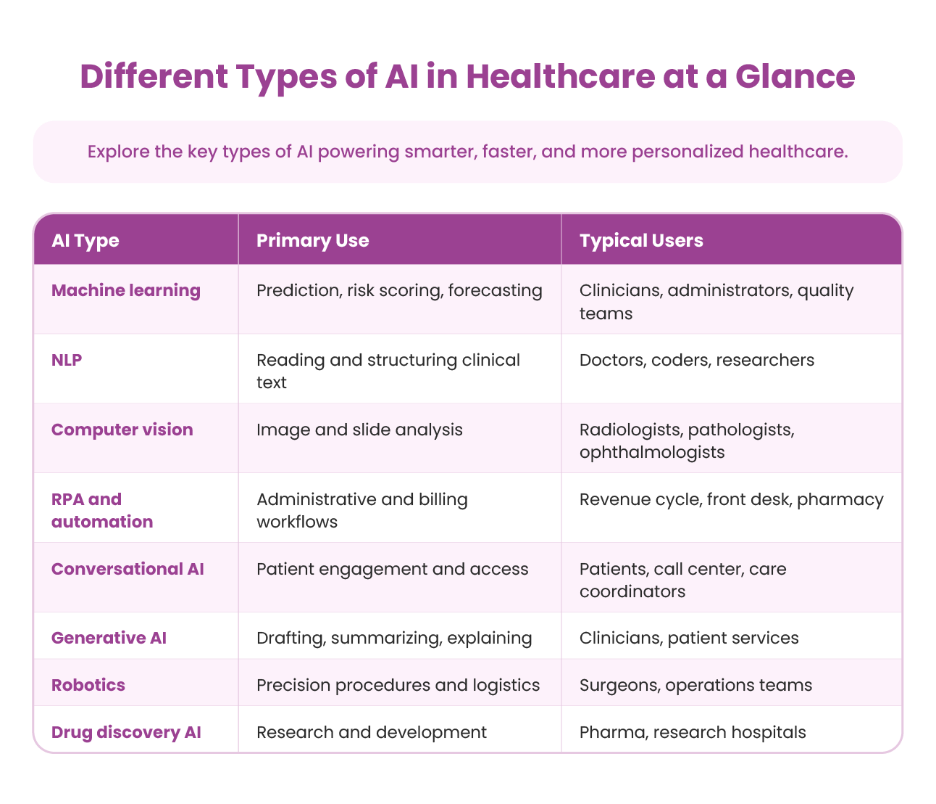
The different types of AI applications in healthcare are broad, but each one serves a distinct purpose like prediction, language understanding, image analysis, automation, conversation, content generation, precision robotics and scientific discovery. sma
The organisations seeing real results are those that match the right technology to a clearly defined problem, build on clean and connected data, and keep clinicians at the centre.
If you are exploring where to begin, review your current HMS and workflows, pick one high-impact use case, and pilot it with clear metrics. Partnering with a provider of integrated healthcare software, such as Ezovion, can help you build the digital foundation that makes every future AI initiative easier to adopt and scale.